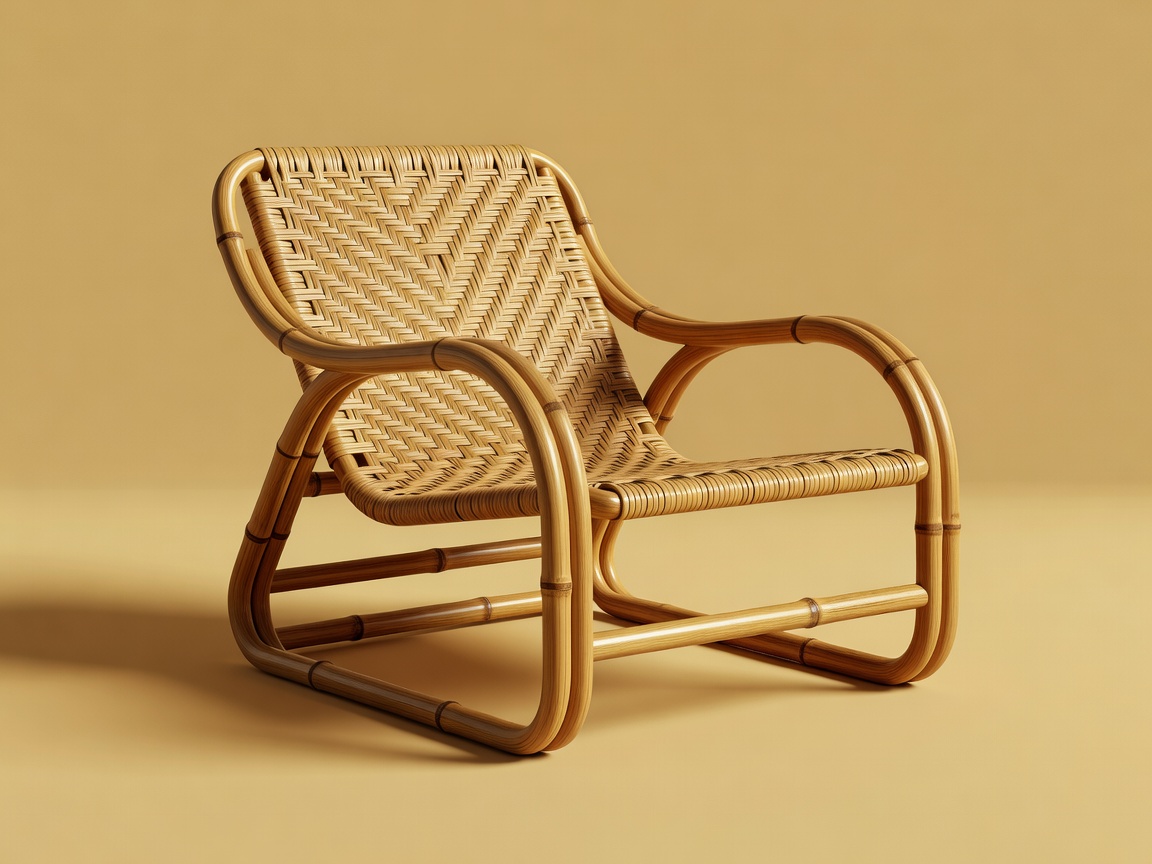
Begin with the chair you sit in
Imagine the lounge chair above, then strip it back. The seat is woven from split strips, which give slightly under the body and spread the load. The arm curves were made by heating strips and setting them in a jig. The legs are short lengths of round culm, each with a node near the floor to resist crushing and splitting where moisture and impact collect. None of these choices is decorative. Each solves a structural problem that bamboo poses differently from wood.
Furniture in bamboo generally falls into three families: whole round culms, split and bent strips, and engineered boards made by laminating or compressing bamboo fiber. Many good pieces combine two of them.
Round-pole furniture
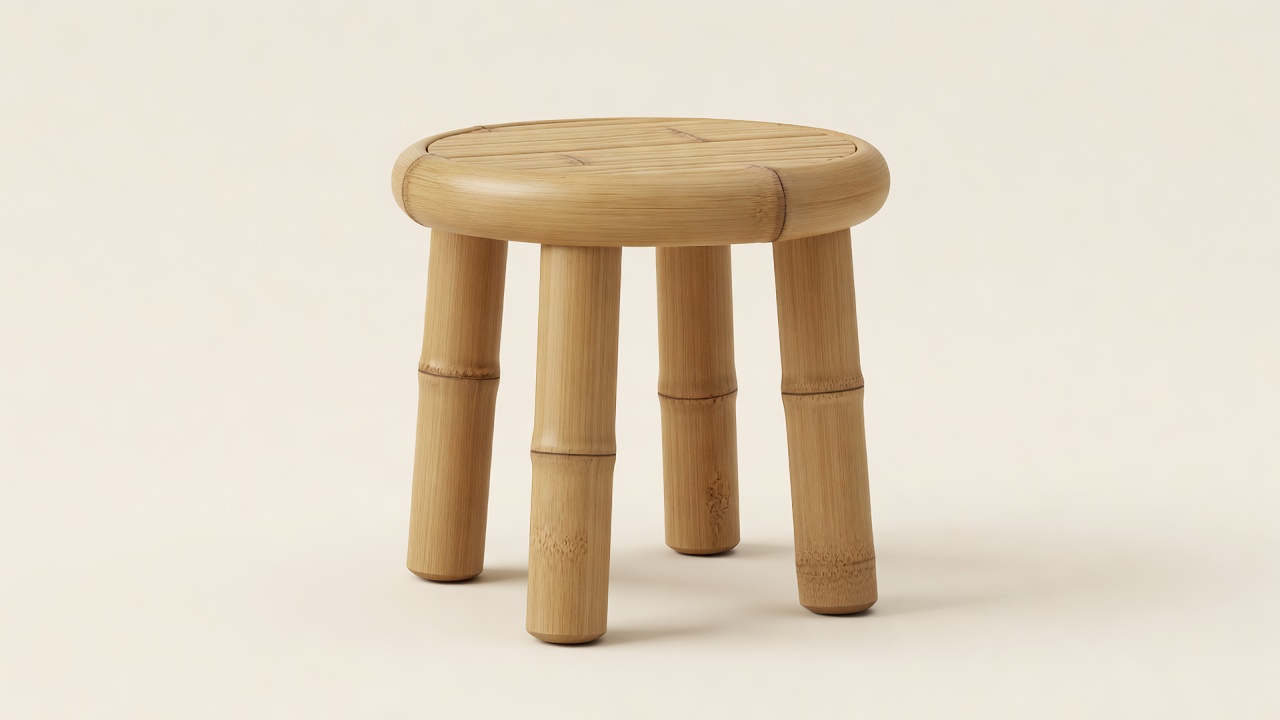
A hollow tube is efficient. For its weight, a round culm is remarkably stiff in bending and strong in compression along its length. Round-pole furniture exploits this with simple frames: stools, benches, shelving and bed frames found in households across South and Southeast Asia, southern China and Latin America.
The challenges are geometric and mechanical. No two culms share the same diameter, taper or wall thickness, so every joint is fitted by hand. Bolts or screws driven through the wall can split it, which is why makers drill generously, position fasteners near nodes, or fill internodes before fixing. Ends are vulnerable; leaving a node at each exposed end closes the tube and keeps out insects and dust.
Bent strips and frames
Splitting a culm and then reassembling it in a new shape opens up curves impossible with round poles. Strips laminated around a mould, or heat-bent individually, can form chair backs, rockers and cantilevered seats. Because the outer skin layer carries most of the strength, strips are oriented so that the skin faces the tension side of the curve. Get that wrong and the piece creaks, then cracks.
Laminated and strand-woven panels
Industrial bamboo boards begin by cutting culms, mostly moso (Phyllostachys edulis), into strips that are planed flat, often boiled or carbonized for colour and stability, then glued into blocks and panels. Much of this production is concentrated in eastern China, including Zhejiang province. The resulting boards cut and machine like timber, enabling flat-pack furniture, tabletops and casework.
Strand-woven bamboo goes further: fibers are crushed, saturated with resin and pressed under high pressure into very dense blocks. The surface becomes extremely hard, ideal for flooring and worktops, but the material now depends heavily on adhesive. When buying engineered bamboo furniture, look for adhesive emission declarations, such as the E1 class in Europe or compliance with CARB Phase 2 limits in the United States, and for FSC certification where available.
| Format | Typical use | Strength source | Watch for |
|---|---|---|---|
| Round culm | Stools, frames, shelving | Hollow tube section and nodes | Splitting at fasteners, uneven diameters |
| Bent strip | Chair backs, rockers | Outer fiber layer in tension | Skin orientation, glue quality |
| Laminated board | Tables, casework | Glued strip blocks | Adhesive type, delamination in humidity |
| Strand-woven | Worktops, flooring | Compressed fiber and resin | Resin share, weight, swelling if unsealed |
Moisture, finish and care
Bamboo is hygroscopic. Round culms can split if moved from humid workshops into dry, heated interiors too quickly, and laminated boards can cup if one face is sealed and the other is not. Penetrating oils and hard wax finishes are common and easy to renew. For outdoor use, pick species and treatments suited to exposure, raise legs off wet ground and accept that untreated surfaces will grey under UV.
Every furniture image on this page is an illustrative 3D render, not a specific commercial product.