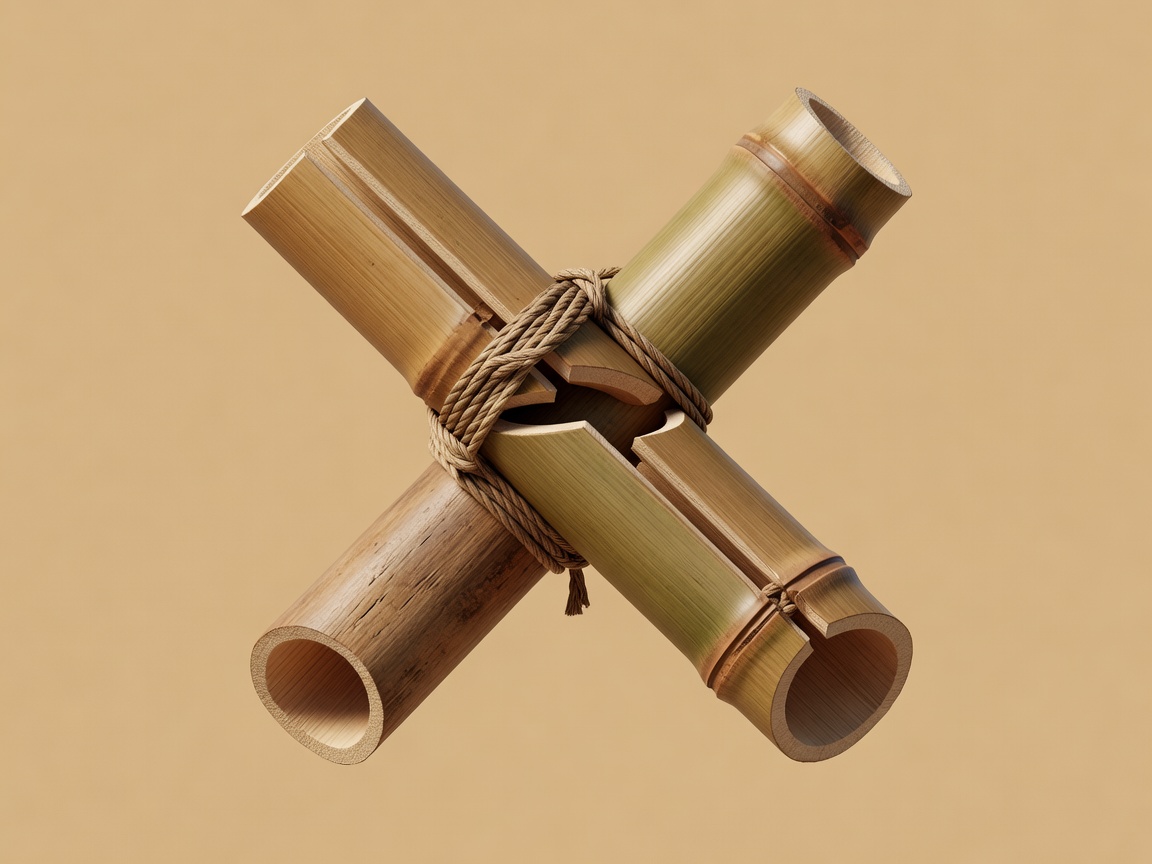
Start at the finished joint
Pick up a well-made bamboo stool and turn it over. Where two poles meet, you will usually find one of three solutions: a saddle-shaped "fish-mouth" cut that cradles the crossing culm, a peg or dowel passing through near a node, or a lashing of cord, rattan or split bamboo skin. Each answer exists because bamboo resists the methods we use for timber. Its walls are thin relative to the diameter, its fibers do not interlock across the grain, and its waxy, silica-rich skin refuses most glues.
So the joint is never an afterthought. It is the point where the maker's understanding of fiber direction becomes visible. Read it well and you can reconstruct almost everything that came before.
Reading the culm before cutting
Craftspeople select culms by age, straightness, wall thickness and node spacing. Many structural species are harvested between three and five years of age, after the wall has hardened but before it begins to decline. Harvest timing within the year matters too: in many traditions culms are cut in the dry season, when starch content is lower and the material is less attractive to powder-post beetles.
Node position is decisive. Nodes are internal diaphragms that stiffen the tube against crushing and splitting. A good maker places load-bearing joints just beside a node rather than in the middle of an internode, where the wall would collapse under a peg or bolt.
Splitting and shaving
Splitting is the gateway technique. A knife or a cross-shaped splitter is driven into the end of the culm and the material opens along its fibers. The split cannot be steered far; it follows the bundles. This is why bamboo strips are naturally straight and why curves must be introduced later with heat or weaving.
Strips are then shaved, almost always from the inner side. The outermost layer holds the highest density of fibers and the hard skin, so preserving it keeps the strip springy and durable. Fine work, such as basket weaving, pulls strips through metal gauges to produce consistent widths and thicknesses before a single strand is woven.
Heat, bending and straightening
Bamboo softens under heat. Over a charcoal fire, gas flame or heat gun, a crooked culm can be straightened in a wooden jig, and a strip can be bent into a tight curve. When it cools, the shape holds. Heat also darkens the surface, and some makers use controlled scorching as both finish and mild protection. Bending works best on fresh, moist material and on strips rather than full culms, which tend to crack when forced.
Weaving traditions
Weaving turns the limitation of straight strips into structure. In Japan, the city of Beppu in Ōita Prefecture is known for its bamboo crafts and hosts a dedicated traditional industry centre. Twentieth-century masters such as Iizuka Shōkansai, named a Living National Treasure in 1982, elevated woven bamboo baskets into sculptural art. In China, regions such as Anji County in Zhejiang combine weaving traditions with large-scale bamboo processing. The patterns differ, from open hexagonal kagome weaves to dense twills, but the logic is shared: tension between crossing strips creates stiffness without a frame.
The joinery sequence
- Mark beside the nodeLocate the joint a short distance from a diaphragm for maximum crush resistance.
- Cut the saddleShape a fish-mouth so the crossing culm bears on a wide curved surface.
- Drill and pegPre-drill to avoid splitting; pegs run through both walls.
- Lash and tensionWrap cord or split skin; wet natural fibers shrink tight as they dry.
Contemporary builders have extended this vocabulary. The Colombian architect Simón Vélez developed joints in which bolts pass through internodes that are then filled with cement mortar, preventing the wall from crushing. That idea made very large spans possible with Guadua angustifolia.
Preservation is part of the craft
Untreated bamboo is vulnerable to insects and fungi. Traditional responses include soaking culms in running water to leach starch, smoking them over fires and curing them with heat. Today, boron salts such as borax and boric acid are widely used, applied by soaking or by vertical sap displacement. None of these makes bamboo indifferent to rain; design detailing still does most of the protective work.
Note: the render above illustrates a technique. It is not a documented artifact or product.